

Changing your DNS for streaming can genuinely help in many homes, mostly by shaving lookup delays off app startup and channel switching. Try a low latency public resolver like Cloudflare's 1.1.1.1 or Google's 8.8.8.8 directly on the device you stream from, then watch for a few days. DNS speeds up the address lookup, not the video itself, so results depend on your ISP, the content delivery network, and your specific device.
TL;DR:
- Switching to a public DNS resolver like Cloudflare's 1.1.1.1 or Google's 8.8.8.8 can reduce DNS lookup delays and improve app startup time and channel switching speed.
- DNS latency varies depending on the resolver's location, caching, and your device's ability to reach the server, so testing on your setup is essential.
- Public DNS improves speed but does not unlock geo-restricted catalogues; Smart DNS services are needed if accessing region-specific content is the goal.
- Changing DNS at the router or device level is straightforward but may be overridden by ISP settings; revert to original settings if issues occur.
- A wired Ethernet connection and proper router placement can significantly reduce buffering for live sports beyond what DNS improvements alone can achieve.
Table of Contents
- How DNS affects streaming performance and startup behaviour
- Public DNS vs Smart DNS vs VPN: which to use for what
- Which resolvers and Smart DNS approaches to try first
- Step by step: change DNS on routers and common streaming devices
- How to test DNS performance on your exact streaming setup
- Home networking and edge routing tips that complement DNS changes
- Managed streaming with local optimization
- FAQ
- Sources
How DNS affects streaming performance and startup behaviour
Every time you open a streaming app, your device asks a DNS resolver to translate a hostname like a content server's address into an IP address it can actually connect to. A single app launch can trigger several of these lookups at once: one for the app's login server, another for the content catalogue, another for the video delivery network itself. Each lookup adds a small delay before the first frame can load, and on a slow or distant resolver, those delays stack up.

Where the resolver sits matters. Anycast resolvers route your query to whichever nearby server node can answer fastest, which reduces DNS lookup latency compared with a single, far away server handling every request. Caching helps too: a resolver that has already seen a popular hostname recently can answer almost instantly instead of chasing the answer across the internet.
None of this touches what happens after the lookup finishes. Your streaming video still has to travel from the content delivery network to your device, and that path depends on:
- Which CDN node your ISP peers with and how congested that link is
- Your actual download throughput during peak hours
- Last-mile issues like old Wi-Fi hardware or a weak signal
- Router configuration unrelated to DNS entirely
One documented case: XDA Developers reported a Netflix connection where DNS response time dropped from 88 ms using the ISP's default resolver to 28 ms after switching to Cloudflare 1.1.1.1 on a smart TV. That is one network's result, not a universal number. Your own mileage depends on your ISP's resolver, your region, and your device, so treat it as a reason to test rather than a guarantee.
Public DNS vs Smart DNS vs VPN: which to use for what
These three tools solve different problems, and mixing them up leads to disappointment. A faster public resolver fixes lookup latency. A Smart DNS service reroutes specific hostnames to help with catalogue access. A VPN encrypts everything and changes your apparent location, at a cost.
- Public DNS (Cloudflare, Google, OpenDNS): cuts resolver latency, often supports encrypted DNS-over-HTTPS or DNS-over-TLS, but does not unlock any geo-restricted catalogue on its own
- Smart DNS: routes only the hostnames tied to certain streaming or catalogue domains through alternate servers, works on smart TVs and consoles that cannot run VPN apps, and does not encrypt your traffic
- VPN: encrypts the full connection and can change your apparent country, but adds processing overhead that can slow throughput, and most smart TVs and streaming boxes have no native VPN app
If your goal is simply a snappier app launch and quicker channel switching, a public resolver change is the first thing worth testing, it is free and takes two minutes. If you are chasing a specific catalogue your device cannot reach, a Smart DNS service aimed at that need is the more direct tool, since it does the hostname routing without touching your whole connection. If privacy or full location masking matters more than speed, accept the VPN's latency tax as the price of that trade-off.
Pro Tip: Test one change at a time. Stacking a VPN, a Smart DNS service, and a new resolver together makes it impossible to tell which one actually fixed anything.
Which resolvers and Smart DNS approaches to try first
Three names show up constantly in resolver comparisons, and each earns its spot for a different reason.
- Cloudflare (1.1.1.1): built on a wide anycast network, Cloudflare documents coverage across 335 or more cities worldwide, which tends to put a fast node close to most home connections.
- Google Public DNS (8.8.8.8): supports DNSSEC validation along with documented DNS-over-HTTPS and DNS-over-TLS endpoints, useful if encrypted lookups matter to you.
- OpenDNS (208.67.222.222): a long-running alternative worth including in your own comparison, particularly if you already use its content filtering features.
To see how these stack up beyond your own living room, DNSPerf runs continuous tests from more than 200 global locations and updates public performance rankings hourly. That global average is useful context, but it is not a substitute for testing on your exact device and connection, since your ISP's peering and your resolver's nearest node matter more than a worldwide average.
A fast resolver only gets you halfway if your device can't reach your preferred catalogue. That is where Smart DNS services come in: they work by routing specific streaming-related hostnames through alternate servers, which can help certain apps recognize a different regional catalogue. Results vary by service, by region, and by how quickly a given streaming platform updates its detection methods, so there is no guarantee any Smart DNS setup keeps working indefinitely.
Step by step: change DNS on routers and common streaming devices
Before touching anything, write down your current DNS settings, usually visible in your router's status page or your device's network settings, so you can revert in seconds if something breaks.
Router level (changes DNS for every device on your network):
- Log into your router's admin page, usually at 192.168.1.1 or 192.168.0.1
- Find the WAN or Internet settings section and locate the DNS fields
- Replace the existing entries with 1.1.1.1 and 1.0.0.1 (Cloudflare) or 8.8.8.8 and 8.8.4.4 (Google)
- Save, reboot the router, and test your streaming device as usual
- If anything misbehaves, return to the saved settings you noted earlier
Smart TVs and streaming boxes:
- On Samsung and LG TVs, DNS settings usually live under Network, then Advanced or Expert settings, where you switch from automatic to manual IP configuration to enter a custom DNS address
- Apple TV: go to Settings, Network, select your Wi-Fi or Ethernet connection, choose Configure DNS, and switch to Manual
- Fire TV: under Settings, Network, select your connection, choose to view or edit it, and enter the DNS fields manually
- A common pitfall on all three: some models revert to automatic DNS after a software update, so recheck after any firmware upgrade
Computers and phones:
- Windows 11 or 10: open Network & Internet settings, select your active connection's properties, and edit the DNS server assignment manually
- Android: go to Settings, Network & Internet, Private DNS, and enter a hostname like one for your chosen resolver's encrypted DNS service
- iOS: DNS changes typically require either a configuration profile or a dedicated app from your resolver's developer, since Apple does not expose a simple manual DNS field everywhere
One catch worth knowing: some ISP routers force DHCP to hand out their own DNS regardless of what you set on the device, which is why a device-level change on the TV or phone itself sometimes succeeds where a router-level change quietly gets overridden. If you are still troubleshooting after a DNS change, our broader troubleshooting guide covers router and network checks that go beyond resolver settings, and our Samsung and LG setup guide walks through compatibility notes specific to those TVs.
How to test DNS performance on your exact streaming setup
The only test that matters is the one run on your actual streaming device, on your actual network, at the time of day you actually watch. A phone test on someone else's Wi-Fi tells you very little about your smart TV's evening performance.
Three tools cover most of what you need. DNSPerf gives you global context on resolver speed and uptime. Command-line tools like dig or nslookup return raw lookup times for specific hostnames, useful for comparing resolvers side by side. A simple A/B test, switching DNS, reloading your main streaming app, and timing how long it takes to reach the home screen, tells you what actually changed for you.
Remember the 88 ms to 28 ms improvement one XDA Developers test documented: it shows real potential, not a promised result for every network, which is exactly why your own test matters more than anyone else's number.

A simple log, built before you start, keeps results honest:
Pro Tip: Run each test three times and use the median, not the first result, since a single lookup can be thrown off by a momentary network hiccup.
Home networking and edge routing tips that complement DNS changes
DNS testing solves one slice of the buffering puzzle, and in our own edge routing work, it is rarely the whole story for live sports. Fast resolution gets the app open quickly, but a live NHL or NFL broadcast still needs a stable, low-congestion path from the content delivery network to your living room, which is exactly what Canadian edge routing is built to shorten.
A few checks cost nothing and often matter more than any resolver swap:
- Run one Ethernet cable to your streaming device during big games. A wired connection resolves buffering that no DNS change ever will.
- Move your router out of a cabinet or corner, and check whether your Wi-Fi is crowded on the default channel.
- If your internet speed is already marginal for the resolution you are streaming, no resolver change fixes that ceiling.
When DNS testing and a wired connection both leave buffering unresolved, that is the point to escalate to your ISP or consider a managed routing solution rather than continuing to tinker.
Managed streaming with local optimization
If testing resolvers and swapping Ethernet cables sounds like more troubleshooting than you want to take on, some managed IPTV services handle that work for you. Such services may employ Canadian edge routing designed to cut buffering on live sports like NHL and NFL, so the groundwork this article covers can be handled on the provider's end instead of yours.
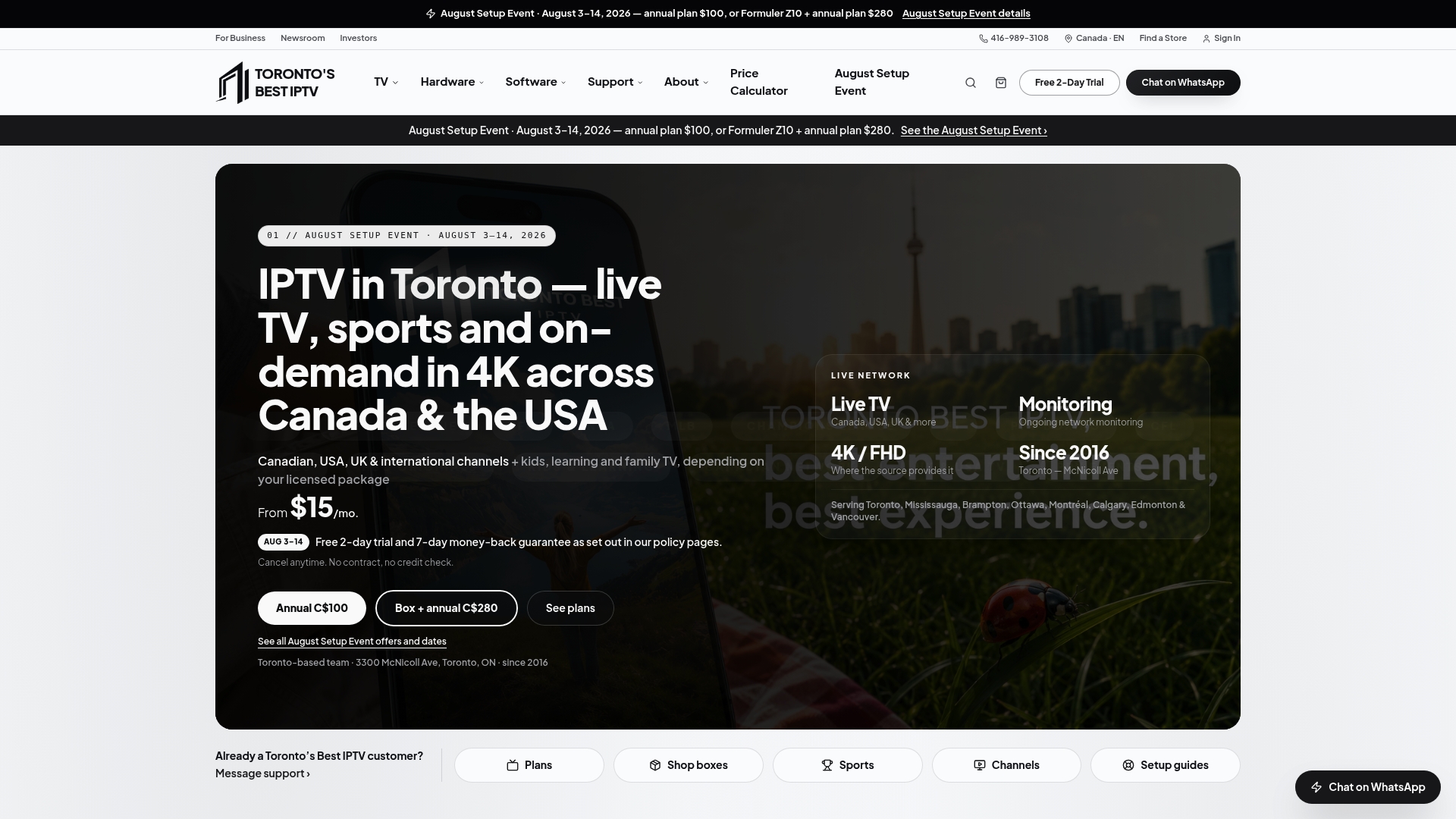
- Plans start at $15 CAD per month, with 6-month and 12-month options available
- A free trial period may let you test actual performance on your own device before committing
- Add-ons like our Premium VOD and 4K library or All-Sports pass extend the lineup for a few dollars more a month
- Pre-configured IPTV boxes arrive ready to go, with a two-year warranty, for anyone who would rather skip the manual setup entirely
Check our plans page to start a trial and see whether a managed connection clears up what DNS testing alone could not.
FAQ
Is 1.1.1.1 the fastest DNS resolver available?
Cloudflare's 1.1.1.1 performs well in most benchmarks thanks to its wide anycast network spanning 335 or more cities, but "fastest" depends on which resolver node sits closest to your specific connection. Dashboards like DNSPerf show global averages, though your own local test is the only way to confirm which resolver is best for your household.
Is Google's 8.8.8.8 or Cloudflare's 1.1.1.1 better for streaming?
Both are reliable, low-latency public resolvers, and the difference for most homes comes down to small margins rather than a clear winner. Google Public DNS offers documented DoH and DoT support alongside DNSSEC validation, while Cloudflare leans on its anycast footprint, so testing both on your own streaming device is the most reliable way to choose.
Is 208.67.222.222 a good DNS option?
That address belongs to OpenDNS, a long-established public resolver that performs reasonably well and adds optional content filtering features some households find useful. It is a reasonable third option to include alongside Cloudflare and Google when running your own comparison, though it is not consistently faster than either in every region.
Does using 8.8.8.8 make your internet faster overall?
No, switching to 8.8.8.8 speeds up DNS lookups, the step where your device translates a hostname into an address, not your actual download or upload throughput. Your overall internet speed depends on your ISP plan and connection quality, while DNS changes mainly affect how quickly apps and websites start loading.
Sources
- I finally fixed my smart TV’s buffering — my internet wasn’t the problem
- What is Anycast DNS? | How Anycast works with DNS
- Secure transports for DNS | Public DNS | Google for Developers
- DNS Performance - Compare the speed and uptime of enterprise and commercial DNS services | DNSPerf