

Paid IPTV is worth it the moment live sports, kids' programming, or daily reliability matter to your household. Free legitimate streams handle casual news watching and background TV just fine. The trade-off is simple: free costs you nothing upfront but demands patience with dead links and no support, while paid trades a monthly fee for stability, a working guide, and someone to call when the screen freezes during overtime. The steps below help you verify either choice before you commit.
TL;DR:
- Paid IPTV offers significantly better reliability during peak viewing hours and live sports, with consistent stream quality and updated program guides.
- Free IPTV sources frequently go stale quickly, lack support, and require time-consuming link hunting that can outweigh their cost savings.
- Legally, authorized free-to-air and public broadcaster apps are safe, but anonymous playlists often operate in a legal and security gray zone, risking malware.
- Testing a service during a major live event and verifying support response times are essential steps before committing to any IPTV provider.
- A two-day trial with local support, like Toronto’s Best IPTV, allows users to evaluate stability, guide accuracy, and device compatibility without long-term commitments.
Table of Contents
- Free IPTV vs paid: comparing quality, cost, and support
- Are free IPTV sources legal, and what are the risks?
- Why does paid IPTV tend to run smoother?
- When is free IPTV actually enough?
- How do you evaluate a paid provider or free source properly?
- What Toronto's Best IPTV brings to this comparison
- Our take: don't let the "free vs paid" debate become a religion
- Try the two-day trial before you commit to anything
- Sources
- FAQ
Free IPTV vs paid: comparing quality, cost, and support
The gap between free and paid IPTV rarely shows up on a quiet Tuesday afternoon. It shows up during the third period of a playoff game, when everyone in the room is watching the same feed you are.
Paid services generally hold up better under pressure because someone is paying to keep the servers running when demand spikes. That infrastructure investment shows up as steadier streams during peak hours and a maintained programme guide with catch-up and video-on-demand libraries that actually update. Comparisons of free and paid IPTV services consistently find that paid platforms sustain higher reliability precisely because the operator has a financial reason to invest in the plumbing behind the picture.
Free, unofficial M3U playlists and APK-based apps tell a different story. They're often built by hobbyists sharing links found elsewhere, and industry explainers note these playlists frequently go stale within days, leaving you hunting for a new source at the worst possible moment. There's no EPG worth trusting, no one to email when a channel disappears, and no guarantee the replacement link tomorrow works any better than the one that died today.
Pro Tip: Before assuming a free source is "good enough," time yourself over one week. If you spend more than 20 minutes hunting replacement links, you've already paid the equivalent of a month's subscription in wasted evenings.
Here's what tends to separate the two in practice:
- Peak-hour stability: paid services usually hold steady during high-demand events; free playlists often buffer or drop entirely.
- Programme guide accuracy: paid platforms maintain EPG and VOD metadata; free sources rarely bother.
- Support when something breaks: paid subscriptions come with a contact point; free sources leave you searching forums.
- Hidden time cost: free M3U links rotate and die often, and the maintenance burden of finding fresh ones can quietly outweigh what a subscription would have cost.
If you want a quick gut check, ask yourself three questions in one sitting: Do I need this to work reliably during live events? Do I have the patience to troubleshoot my own setup? Would I rather pay a small monthly fee or spend an hour a week chasing links? Your answers will tell you which side of the free vs paid IPTV comparison actually fits your household.
Are free IPTV sources legal, and what are the risks?
Not all free IPTV is created equal, and the legal line matters more than most viewers realize. Authorized free-to-air platforms, public broadcaster apps, and FAST (free ad-supported streaming television) channels operate with proper licensing. Anonymous M3U playlists and sideloaded APKs pulled from sketchy forums are a different animal entirely, often rebroadcasting content without any rights to do so.
Canada's broadcasting framework, overseen through CRTC guidance on delivery models, draws a clear distinction between licensed broadcasters and unauthorized re-streams. WhistleOut's explainer on IPTV in Canada makes the same point from a consumer angle: telecom-delivered IPTV is licensed and accountable, while many independent free services operate in a grey zone with no such accountability. Enforcement isn't theoretical either. CBC reported on a federal court banning a piracy site, showing that unlicensed streaming operations can and do face real legal consequences.
Security is the other half of the risk equation. Sketchy download sites pushing "free premium IPTV" APKs are a common vector for malware, and sideloading apps outside official stores strips away the vetting that platforms like Google Play or Apple's App Store normally provide.
Four steps to vet any free source before you install anything:
- Check whether the provider or app publishes a business name, contact address, or support email. Anonymity is a red flag.
- Search the app or playlist name plus "malware" or "review" before downloading anything.
- Confirm the source matches a known, legitimate broadcaster or FAST platform rather than an anonymous aggregator.
- Test the stream briefly before committing your device credentials, home network access, or payment information.
Pro Tip: If a "free" app demands unusual permissions (contacts, SMS, camera) for a TV streaming function, that's a hard stop. Legitimate streaming apps have no reason to ask for that access.
Why does paid IPTV tend to run smoother?
The path a signal takes before it reaches your screen explains most of the quality gap between free and paid IPTV. That path runs from the original broadcast source, through an encoder that compresses the signal, across a content delivery network (CDN), through your internet provider, and finally into your home network and device. Instability can creep in at any link in that chain, and paid providers invest specifically in strengthening the weak points.
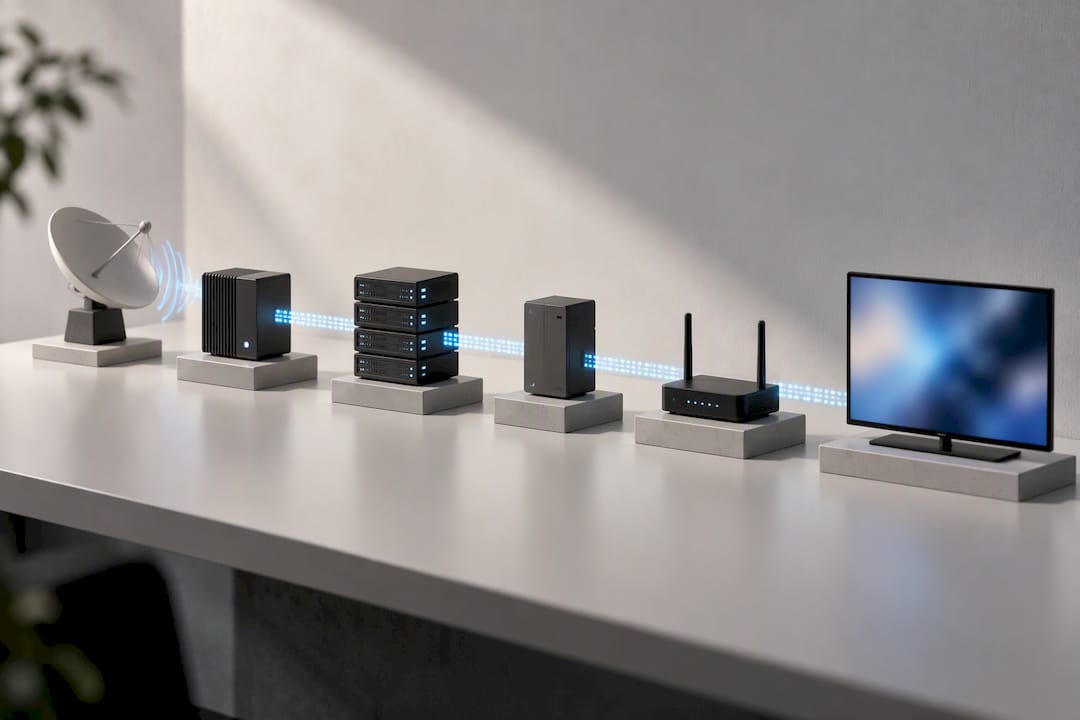
Adaptive bitrate streaming is one of the quieter reasons paid services buffer less. It automatically adjusts video quality in real time based on your connection speed rather than freezing outright when bandwidth dips, the same technology behind smooth playback on major video platforms. Free sources built on borrowed or overloaded servers rarely have this kind of anti-freeze engineering behind them.
EPG accuracy, catch-up TV, and VOD libraries depend on server-side metadata that someone has to actively maintain. A paid operator has a commercial reason to keep that metadata current. A free playlist maintained by volunteers or scraped from other sources usually doesn't, which is why the programme guide on free IPTV so often shows the wrong show at the wrong time, or nothing at all.
Device compatibility adds another layer of risk. Streaming through an official, vetted player app on a smart TV, Fire Stick, or Android box means the software has passed some baseline review. Sideloaded APKs bypass that review entirely, which is convenient for accessing free sources but removes a layer of protection against malicious code.
Watch for these signs the delivery chain is weak on any service you're testing:
- Frequent buffering specifically during high-traffic hours (evenings, live sports).
- A programme guide that's blank, delayed, or clearly mismatched to what's airing.
- No catch-up or VOD option despite the provider claiming to offer it.
- An app that only works after sideloading from an unofficial APK file.
When is free IPTV actually enough?
Paying for IPTV isn't automatically the smarter move for every household. If you mostly watch local news, a public broadcaster's app, or background television while doing other things, a legitimate free service often covers everything you need.
FAST channels and public broadcaster apps are the safest and most sustainable free option, since they're licensed and don't disappear overnight the way anonymous playlists do. Curated, publicly maintained repositories of authorized free-to-air channels exist precisely for viewers who want legitimate access without a subscription, and they're worth bookmarking before you consider anything else.
Free IPTV also suits viewers who genuinely enjoy the tinkering side of the hobby. If troubleshooting a dead link on a Sunday morning sounds like a minor annoyance rather than a dealbreaker, and you're not relying on the stream for anything time-sensitive, the occasional failure is a fair trade for zero monthly cost.
A hybrid approach works well for a lot of households. Pair a free legal app for daily news and background viewing with a small, targeted paid add-on for the handful of things that actually matter, like live sports coverage or a specific premium channel package. You get free coverage for the boring parts of your week and paid reliability where it counts.
Free IPTV tends to be enough when:
- You mainly watch local news, weather, or general-interest programming.
- You already use a public broadcaster's official app for most of your viewing.
- You're comfortable troubleshooting your own setup without customer support.
- Nothing you watch is truly time-sensitive, like a live game you can't miss.
How do you evaluate a paid provider or free source properly?
Whether you're testing a paid subscription or vetting a free playlist someone recommended, the evaluation process is nearly identical. You're checking for transparency, verified sources, and honest handling of your data, not just whether the picture looks decent on day one.
Run through this checklist before trusting any provider with your household's viewing:
- Operator transparency. Does the business have a real name, address, and contact method? Anonymous operators, free or paid, deserve suspicion.
- App and source verification. Is the app available through an official store, or does it require sideloading? Sideloading isn't automatically dangerous, but it removes a layer of vetting.
- Privacy policy and data practices. Does the provider publish what it collects and how it's used? No policy at all is a warning sign.
- Support and refund terms. Can you actually reach a human, and is there a stated refund or trial policy if the service doesn't work for you?
A meaningful evaluation trial tests three things specifically: peak-hour stability during a live event, EPG and VOD accuracy against the actual schedule, and how quickly support responds when you flag a problem. Running the trial during a big game or season premiere, rather than a quiet weekday afternoon, tells you far more than a calm test ever will.
Pro Tip: Ask any provider, paid or free, one direct question before committing: "What happens if this doesn't work during a live event?" A vague answer or no answer at all is your signal to walk away.
Red flags that should end a trial immediately: no way to contact a real person, a refund policy that changes when you ask about it, or a stream that can't hold up through one full live broadcast.
What Toronto's Best IPTV brings to this comparison
A local IPTV provider operating since 2016 emphasizes technology aimed at reducing buffering during high-demand moments like NHL and NFL broadcasts, addressing the peak-hour stability problem that trips up so many free sources.
Plans start from $15 CAD per month, and the two-day free trial lets you test peak-event stability, EPG accuracy, and device compatibility before paying for anything. That trial period exists to answer the exact questions the evaluation checklist raises: does the stream hold during a live game, does the guide match the schedule, and does support actually respond?
A few of the concrete signals worth checking during your own trial:
- Technology aimed at minimizing buffering on live sports.
- Local customer support.
- Pre-configured IPTV boxes carrying a warranty for those who'd rather skip the setup fuss.
- A trial window to test the service before committing.
Verify refund and support behaviour for yourself during that trial window rather than taking any provider's word for it, Torontobestiptv included.
Our take: don't let the "free vs paid" debate become a religion
Most households don't need a philosophy on this. They need to know whether the game will still be playing at 9 p.m. on a Saturday. If sports, kids' programming, or daily reliability matter in your house, pay for it and stop losing evenings to dead links. If you mainly watch news and don't mind the occasional hiccup, a legitimate free service is a perfectly rational choice.
Weigh your own time honestly. An hour a week hunting for working links adds up faster than most people admit. Test any paid option through a trial before committing to a full year.
— Aj
Try the two-day trial before you commit to anything
Torontobestiptv is the practical middle ground between chasing free links and locking into a full year of cable. Instead of hunting for playlists that die every few days, you get a two-day free trial that lets you test the exact things that matter: how the stream holds up during a live sports broadcast, whether the programme guide actually matches what's airing, and whether the app runs cleanly on your device.
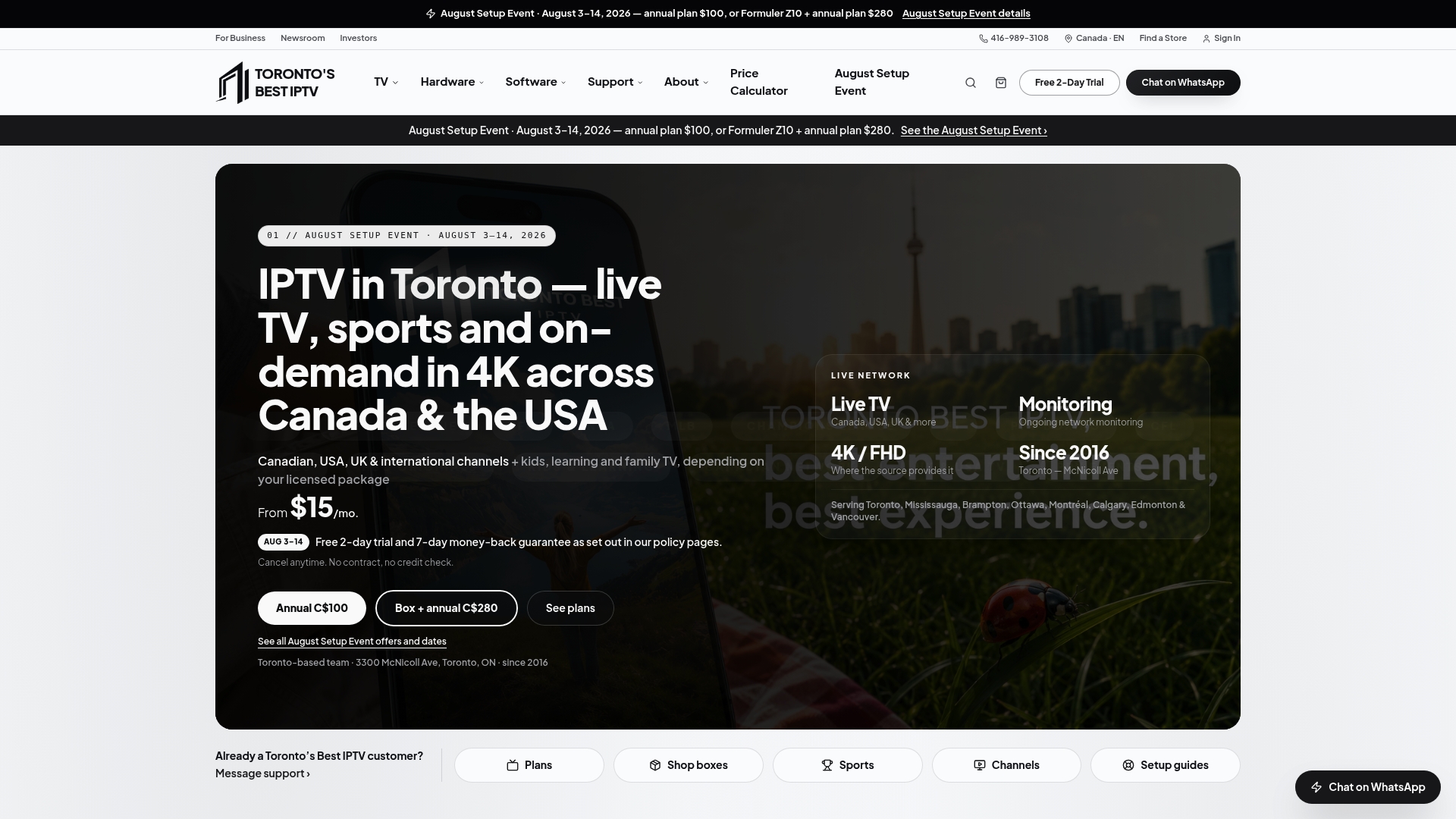
Use the trial window the way you'd test anything important. Watch a live game during peak hours, flip through the EPG to check accuracy, and try the app on whatever device your household actually uses. If it holds up, plans start from $15 CAD per month, with 6-month and 12-month options available for households ready to commit longer. Not sure which add-ons make sense for your setup? The pricing calculator breaks down options like the Premium VOD + 4K library and the All-Sports pass so you're not paying for features you won't use. Prefer a plug-and-play device over configuring your own? Browse pre-configured IPTV boxes built to work out of the box.
Local Toronto-based support is there if anything goes sideways during setup. Confirm refund terms directly with support before your trial ends, and decide from a position of actual evidence rather than a guess.
Sources
For deeper context: CRTC's broadcasting guidance explains Canadian delivery models, and WhistleOut's IPTV explainer covers the Canadian provider landscape in plain terms.
- CRTC — broadcasting policy and related guidance
- CBC News — federal court bans piracy website (example coverage)
- Comparing free and paid IPTV services — Computer Republic
FAQ
Is Canada blocking IPTV?
Canada isn't blocking IPTV as a technology, since licensed telecom-delivered IPTV operates legally under CRTC oversight. Unlicensed piracy operations have faced court action, as CBC reported on a federal court banning a piracy site, but that targets unauthorized re-streaming, not IPTV in general.
Is it worth paying for IPTV?
Paying for IPTV is worth it if you watch live sports, need reliable programming during peak hours, or want a working support line when something breaks. Free sources save money but come with maintenance time and instability that can offset the savings, particularly given how often free playlists go stale.
Which IPTV subscription is best?
The right subscription depends on what you watch most, so run the trial checklist yourself: test peak-hour stability, EPG accuracy, and support responsiveness before committing. Torontobestiptv's two-day trial is built for exactly that kind of hands-on evaluation.
What is the average price of IPTV in Canada?
Pricing varies by provider and plan length, so check current listings directly rather than relying on averages that shift often. Torontobestiptv's plans start from $15 CAD per month, with longer-term options available at different rates on the same page.