

Edge routing for streaming pushes the decisions about where your video comes from, and how it travels, out to nodes near you instead of one distant server. The result: shorter delivery paths, faster startup, and far fewer rebuffer spikes when everyone tunes in at once, like during a Leafs playoff game or a big MLB series.
The practical payoff shows up in two places you actually notice: the video starts almost instantly, and it doesn't stall when a stadium's worth of other viewers hit "play" at the same moment. That's the promise, anyway. Whether it delivers depends on a handful of underlying mechanisms that we'll unpack:
- Edge nodes placed physically closer to viewers
- QUIC and multi-path transport protocols
- Distributed relay networks that pool capacity across CDNs and ISPs
Key Takeaways
Edge routing reduces streaming latency and buffering by processing data at nodes near viewers and using multi-path transport to aggregate capacity across CDNs and ISPs.
| Point | Details |
|---|---|
| Edge nodes shorten paths | Processing data closer to viewers directly cuts the physical distance a video signal travels. |
| QUIC and multi-path matter | These transport protocols reduce handshake delay and let clients pull data from several sources at once. |
| Hybrid CDN-edge handoff | Reliable CDN delivery for startup segments, then edge delivery for sustained playback, balances speed and cost. |
| Blackouts stay enforced | Edge routing improves speed and reliability but does not bypass region-based licensing or blackout rules. |
| Test during peak demand | Startup latency and rebuffer counts during high-concurrency events reveal far more than a quiet-hour test. |
Table of Contents
- What is edge routing streaming, architecturally?
- Which protocols make edge routing fast?
- What does edge routing actually improve, and where's the catch?
- How do operators build reliable edge routing systems?
- What should you check before trusting a streaming service?
- How Toronto's Best IPTV applies these principles
- Does edge routing actually fix blackouts and buffering?
- How does edge routing protect against outages and attacks?
- What do real-world edge routing deployments look like?
- How do you measure edge routing performance?
- What actually matters when you're evaluating this technology
- Frequently asked questions
- Sources
What is edge routing streaming, architecturally?
Picture two designs. The first is a simple edge gateway: one node near you, forwarding traffic from a central origin. It helps, but if that single node gets overloaded during a Grey Cup broadcast, you're stuck. The second design, distributed relay architecture, is what serious streaming operators actually build. Relays coordinate across cloud, CDN, and ISP boundaries so they behave like one unified delivery fabric rather than a chain of separate hops, according to Oracle's engineering team.
That coordination isn't automatic. It runs on telemetry, constant measurements of latency, packet loss, and congestion, feeding a decision engine that reroutes traffic before a viewer ever notices a hiccup. This is how services aggregate capacity across multiple CDNs and ISPs at once, which matters enormously when concurrent demand spikes during a live event rather than staying flat like it does for on-demand catalogue browsing.
Here's the sequence most well-built systems follow:
- A viewer requests a stream; the system checks which relay paths currently have the healthiest telemetry.
- The first few segments load from a CDN, because CDNs have proven reliability for the critical startup window.
- Once playback is established, delivery hands off to edge relays for the sustained, steady-state portion of the stream.
- Telemetry keeps monitoring in the background, ready to reroute if a path degrades.
That handoff, CDN for the opening seconds, edge for the long haul, is the core trade-off behind almost every modern streaming architecture.
Pro Tip: If a service brags about "edge delivery" but can't explain how it handles the first five seconds of playback, ask about it directly. That startup window is where most buffering complaints actually originate.
Which protocols make edge routing fast?
Two protocol shifts explain most of the latency gains you'll hear about. The first is QUIC, which replaces the older TCP handshake with something faster and multiplexes several data streams over one connection so a single lost packet doesn't stall everything else. The second is multi-path delivery: instead of pulling your stream from one source, the client requests data simultaneously from several edge paths and stitches the results back together in order.
That second piece sounds simple but is genuinely clever engineering. A well-built client keeps a global request queue, separate queues per path, and receive buffers that reassemble packets in the correct playback order even when they arrive out of sequence from different edge devices, an approach demonstrated in the HyperEdge system built by researchers at NUS Comp Sci. It's the streaming equivalent of ordering from three delivery drivers at once and trusting your kitchen to plate the meal in the right order regardless of who arrives first.
What does this buy you in practice?
- Fewer full stalls, because losing one path doesn't mean losing the stream
- Faster recovery from network hiccups, since QUIC handles packet loss without renegotiating the whole connection
- Better performance on mobile networks, where connection switching used to mean a visible pause
In well-peered, localized setups, this combination can achieve ultra-low round-trip latency, reportedly under a few milliseconds, according to a technical review of QUIC performance. That's not a number every household will see. It depends heavily on how close the nearest healthy edge node actually is, but it shows what the technology is capable of when the conditions line up.
What does edge routing actually improve, and where's the catch?
The upside is real for anything with a crowd. Live sports, breaking news, big product launches, anything where thousands of people hit "play" in the same sixty seconds, benefits most from distributed capacity, because no single server has to absorb the whole spike.
- Lower startup delay for live events with sudden concurrent demand
- Fewer rebuffer events when regional traffic surges
- Lower delivery cost at scale, since edge capacity is often cheaper than pure CDN bandwidth
The catch is complexity. Running a hybrid CDN-edge system means managing two delivery layers instead of one, plus the orchestration logic connecting them. Switch from CDN to edge too early and you risk missing your startup targets; switch too late and you're paying CDN rates you didn't need to, a balance Oracle's architecture notes flag as an ongoing operational tension rather than a solved problem. As a viewer, you'll mostly see the trade-off as a very short pause at the start of a stream, followed by smoother sailing.
How do operators build reliable edge routing systems?
Good implementations don't happen by accident, and the choices behind them explain a lot about why some services buffer constantly while others barely blink during a big game.
- Relay placement. Operators partner directly with CDNs and ISPs to place relay nodes as close to population centres as the network topology allows, rather than relying on a handful of distant regional hubs.
- Telemetry-driven steering. Live measurements of congestion and loss feed routing decisions in real time, so traffic gets steered away from a degrading path before viewers notice anything.
- In-order delivery management. Because multi-path systems pull data from several sources at once, the client needs queuing logic that reassembles packets correctly even when one path is slower than the others.
- NAT and firewall handling. Edge connections sometimes need hole-punching techniques to establish direct paths through home routers and carrier NATs, and a poorly handled negotiation here is a common, invisible source of buffering that has nothing to do with your internet speed.
- Switch timing between CDN and edge. As covered above, this handoff point determines whether startup feels instant or sluggish, and tuning it correctly is arguably the single hardest part of the whole design.
Edge routers themselves, the physical or virtual devices sitting at these network boundaries, typically support standard routing protocols like BGP and OSPF and can host virtual services for traffic optimisation and quality-of-service policies, per Cisco's technical overview. That QoS layer is what lets a provider prioritise live video traffic over, say, a background software update happening on the same connection.
What should you check before trusting a streaming service?
You don't need to audit anyone's network architecture. You just need to know which claims are worth testing during a trial period.
- Does the service mention edge routing, distributed relays, or direct ISP peering anywhere in its marketing or support docs?
- Does it support QUIC or similarly modern transport protocols, even if the marketing doesn't use that exact term?
- How fast does a stream start on a wired connection versus Wi-Fi, timed with a stopwatch during peak evening hours?
- How many rebuffer events happen during a high-concurrency moment, like the opening faceoff of a nationally broadcast game?
Your own network matters just as much as the provider's. Outdated router firmware, a restrictive NAT type, or no quality-of-service prioritization for streaming traffic can undercut even excellent edge infrastructure on the provider's end.
Pro Tip: Run your startup and rebuffer tests twice, once during a quiet weekday afternoon and once during a Saturday night live sports window. The gap between those two results tells you more about a service's real-world edge routing than any spec sheet.
How Toronto's Best IPTV applies these principles
Torontobestiptv has built its Canadian delivery around the same edge routing principles covered above, and it backs the approach with terms you can verify yourself.
- Plans start from just $15 a month, with tiers that include live sports, kids' programming, and multilingual channels
- A two-day free trial lets you run your own startup and buffering tests before paying anything
- Local Canadian customer support has operated out of Toronto since 2016
- Device troubleshooting tutorials walk you through firmware and network settings that affect buffering directly
Fast load times during live sports aren't a marketing slogan when a provider lets you test it for free before committing to a subscription.
Faster load and fewer stalls during marquee events like live NHL broadcasts are exactly the outcomes edge routing is designed to produce; a Canadian-focused delivery setup and a no-risk trial are how you confirm it for yourself rather than taking anyone's word for it. If you're weighing plans, the pricing calculator breaks down multi-device costs, and the full IPTV guide covers everything else worth knowing before you switch.
Does edge routing actually fix blackouts and buffering?
Edge routing improves buffering, but it does not touch blackout restrictions, and mixing those two up leads to disappointment. Faster, more local delivery paths mean fewer stalls and quicker recovery from packet loss, but every edge node still knows its own geography. Licensing checks based on IP location remain fully enforced regardless of how efficient the routing underneath is, according to documentation on edge geo-blocking. So if you're dealing with an NHL blackout in Canada or an MLB blackout tied to your region, edge routing won't route around that. It's a separate problem, solved by licensing agreements, not network engineering. What edge routing does fix is the viewing experience once you're watching content you're actually authorized to see: smoother playback, quicker recovery from a Wi-Fi dropout, and fewer moments where the spinning wheel shows up during the third period.
How does edge routing protect against outages and attacks?
Distributing delivery across many relay nodes instead of one central server has a security benefit that often gets overlooked: it's much harder to knock an entire service offline. A distributed denial-of-service attack aimed at a single origin server can be devastating, but the same attack against a network spread across dozens of edge nodes and multiple ISPs has to hit far more targets to cause the same damage.
Data integrity matters just as much as uptime. Edge routers sitting at network boundaries can host virtual services, including firewall and traffic-inspection functions, that filter malicious packets before they ever reach the delivery layer, a role Cisco documents as standard for boundary devices. That inspection layer also helps catch corrupted or tampered segments before they reach your screen as a garbled frame or a stream that stalls for no obvious reason.
Multi-path delivery adds a quieter security advantage too. Because a client is pulling data from several sources simultaneously rather than trusting one path completely, a single compromised or misbehaving relay has less ability to disrupt the whole stream. The client's queuing logic simply deprioritizes that path and leans on the healthy ones instead. None of this makes a streaming platform unhackable, but it does mean the attack surface is spread thin rather than concentrated in one obvious place worth targeting.
What do real-world edge routing deployments look like?
The clearest public example comes from HyperEdge, a system that pairs a client-side library with a tracker cluster and multi-path protocol to pull video simultaneously from many edge devices, falling back to CDN delivery only for the opening segments, as detailed in the NSDI research paper on the project. That fallback design solves the exact startup problem operators worry about most: guaranteeing a fast, reliable beginning while shifting the more expensive, sustained delivery load onto cheaper edge capacity.
Oracle's video edge architecture takes a similar philosophy at a larger scale, orchestrating relays across cloud, CDN, and ISP infrastructure so they aggregate into what functions as one delivery network rather than a patchwork of separate systems, according to Oracle's own engineering writeup. That kind of coordination is what allows a live event with genuinely massive concurrent viewership, think a World Cup final or a major awards show, to stay watchable instead of collapsing under its own popularity.
On-demand streaming benefits differently. Since demand isn't concentrated into one narrow live window, edge caching can pre-position popular titles at nodes near dense population centres, cutting the average distance data has to travel for the shows and movies people actually watch most. Live and on-demand delivery end up solving related but distinct problems with the same underlying edge infrastructure, one optimized for sudden concurrent spikes, the other for steady, predictable demand.
How do you measure edge routing performance?
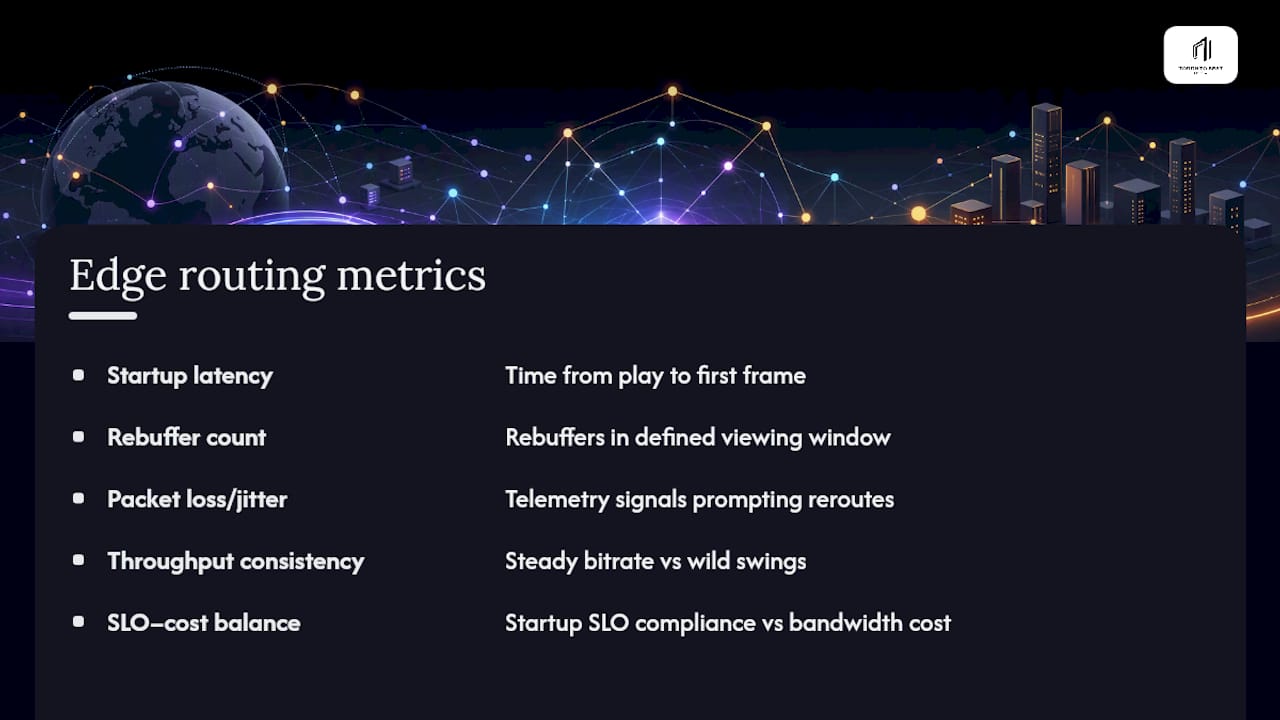
Startup latency is the first metric worth tracking, measured as the time between pressing play and the first frame rendering. Anything creeping past a couple of seconds on a decent connection suggests the CDN-to-edge handoff isn't tuned well. Rebuffer count during a defined viewing window, say, the full first period of a hockey broadcast, tells you how the system behaves under sustained real-world conditions rather than a single snapshot.
Packet loss and jitter on the delivery path matter too, since these are the raw signals that telemetry-driven routing systems use to decide when to reroute traffic away from a degrading path. If you have access to network diagnostic tools, watching these numbers during a known high-traffic event, a Stanley Cup game or a major UFC card, gives you a much more honest picture than testing on a quiet Tuesday afternoon.
Throughput consistency, whether the delivered bitrate holds steady or swings wildly, reflects how well multi-path aggregation is working behind the scenes. A system pulling from several healthy edge paths should show smoother throughput than one relying on a single connection, even when total available bandwidth is similar. For operators, the harder metric is the balance between startup SLO compliance and steady-state cost efficiency, since switching from CDN to edge too early or too late shows up as either buffering complaints or unnecessary bandwidth expense, a tension Oracle's architecture documentation treats as a permanent balancing act rather than something you fix once and forget.
What actually matters when you're evaluating this technology
The research on edge routing points to a conclusion that most marketing copy glosses over: the technology's biggest win isn't raw speed, it's consistency under pressure. A service that streams beautifully to three people on a Tuesday afternoon tells you almost nothing. What separates well-engineered edge routing from a glorified CDN with better branding is what happens when fifty thousand people in the same region hit play within the same two minutes.
Conventional advice tells you to check download speed and call it done. That's incomplete. Your connection speed matters less than how gracefully a service's infrastructure handles the moment everyone else on your street also decides to watch the game. The HyperEdge research on multi-path client scheduling makes this clear: it's not about having one fast path, it's about having several imperfect ones and being smart enough to use all of them at once.
If you're evaluating a provider, prioritize the startup-to-steady-state handoff over any single speed number they advertise. Ask what happens during a spike, not what happens on an average Tuesday. That's the question conventional wisdom skips, and it's the one that actually predicts whether you'll be staring at a spinning wheel during the third period.
Frequently asked questions
What is edge routing in simple terms? Edge routing means moving the decisions about where your video data comes from, and how it travels, to network nodes physically closer to you instead of one distant central server. That shorter path is what cuts down startup delay and buffering.
Does edge routing help with NHL blackout or MLB blackout restrictions in Canada? No. Edge routing improves delivery speed and stability, but region-based blackouts and sports licensing restrictions are enforced through IP-based location checks that operate independently of the routing technology underneath.
What's the difference between edge computing streaming and traditional CDN delivery? A traditional CDN caches content at regional hubs and serves everyone from the nearest one. Edge computing streaming goes further, distributing both processing and routing decisions across many smaller, closer nodes, often coordinated with multi-path protocols for extra reliability.
Why does my stream buffer even with fast internet? Fast download speed doesn't guarantee a short delivery path or good routing on the provider's side. Router firmware, NAT type, and how well a provider's edge network is peered with your ISP all affect buffering just as much as raw bandwidth.
Is edge routing streaming worth paying attention to when choosing an IPTV provider? Yes, particularly if you watch live sports or other high-concurrency events regularly. Ask providers directly whether they use distributed relays or edge delivery, and use a free trial period to test startup time and rebuffering during an actual live broadcast rather than relying on marketing claims alone.
Sources
- Oracle Video Edge: Orchestrating large-scale live streaming across distributed networks
- What is an edge router? - Cisco